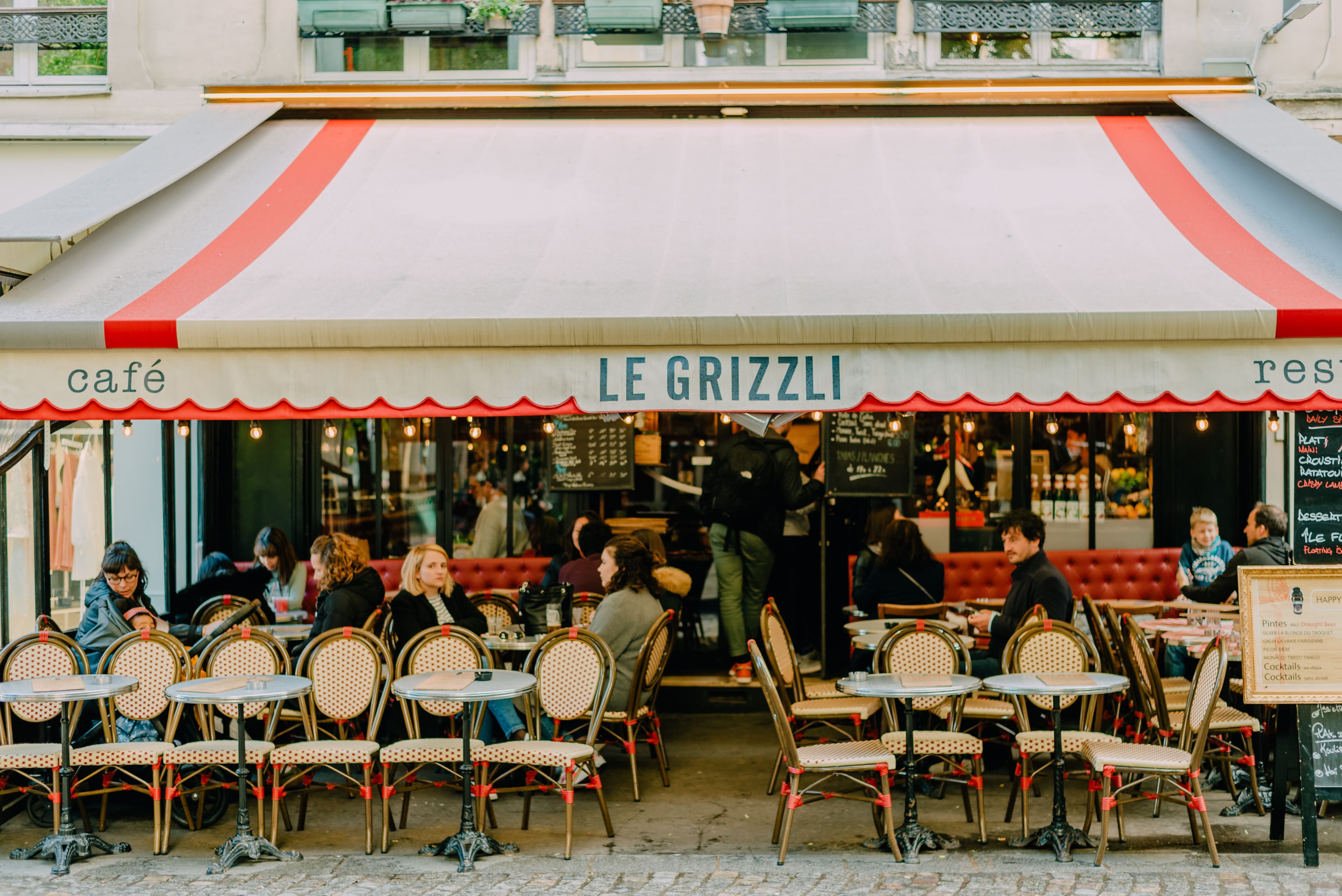
French for the café and the dinner table (and a little flirting)
Social French for the café, the dinner table, and a little flirting: real phrases for greetings, ordering, compliments, and goodbyes.
Social French for the café, the dinner table, and a little flirting: real phrases for greetings, ordering, compliments, and goodbyes.
Textbook French teaches you that the pen of my aunt is on the table. Useful, in a very specific emergency. What it rarely teaches you is what to say when someone leans in to kiss your cheek, or how to turn down a third helping without seeming to insult the cook.
This is a guide to the French people actually use at the café and the table. The grammar is correct, the accents are checked, and the register is the kind you can use with people you have just met. If freezing in the moment is your real problem, we wrote more about that in stop freezing mid-conversation.
Start with the word, not the kiss. In France you greet before you do anything else. Walking into a small shop without a bonjour reads as rude, even if you only want a baguette.
Bonjour, comment allez-vous ?
Hello, how are you? Polite and safe with anyone you do not know well.
Bonsoir, ça va ?
Good evening, how are things? Use bonsoir from roughly late afternoon onward; ça va is the relaxed version.
Enchanté de faire votre connaissance.
Pleased to meet you. A warm first-meeting line; women say enchantée.
Then there is la bise, the cheek kiss. Among friends and at relaxed gatherings it is normal. In a work setting a handshake is safer, and you can always follow the other person's lead. The number of kisses varies by region, which is a national running argument and not something you need to win.
Tu or vous
When in doubt, use vous. It is the respectful default with strangers, older people, and anyone in a professional role. You can switch to tu once someone invites it, often with on se tutoie? People rarely take offence at vous. They do notice an over-familiar tu.
The trick is softness. Je veux means I want and sounds blunt. The conditional je voudrais means I would like and is what everyone actually says.
Je voudrais un café, s'il vous plaît.
I would like a coffee, please. Your everyday ordering line; un café means an espresso.
Qu'est-ce que vous me conseillez ?
What do you recommend? Good when the menu is a mystery and you want the waiter on your side.
L'addition, s'il vous plaît.
The bill, please. In France the bill does not come until you ask, so you will need this one.
C'était délicieux, merci.
That was delicious, thank you. A small kindness on the way out that lands well.
A French meal has a rhythm. It is slower than you expect, courses arrive in order, and lunch in particular is taken seriously. Compliment the food and the host, and you are most of the way there.
Default to vous with strangers, older people, and anyone professional. Switch to tu only when invited, often with on se tutoie? Vous rarely offends; an early tu sometimes does.
Among friends and at relaxed gatherings it is normal; in work settings a handshake is safer. Follow the other person's lead, and do not worry about the number of kisses, which varies by region.
Use the conditional je voudrais (I would like) rather than je veux (I want), and end with s'il vous plaît. Ask qu'est-ce que vous me conseillez? if you want the waiter's help.
Hedge it. Je ne suis pas sûr d'être d'accord or je trouve que frames it as your view, not a verdict. Save the stronger lines for friends and a lively debate.
Try c'était parfait, mais je n'ai plus faim (it was perfect, but I am full). Praise the food first, then decline, so it reads as satisfaction rather than rejection.
The one that's coming up. Litani turns it into practice you say out loud, so the real thing is not the first time.
Ordering well is mostly politeness and a soft conditional: je voudrais does more than je veux.
At the table, a compliment to the host and a light opinion go further than a perfect verb tense.
Disagreeing is fine. Doing it gently, with je ne suis pas sûr or c'est-à-dire, keeps it friendly.
Capture the social moment you dread, then say it out loud a few times before you are in the room.
C'est vraiment délicieux, vous vous êtes surpassé.
This is really delicious, you have outdone yourself. A generous compliment to the host; use surpassée if she is a woman.
Vous pourriez me passer le pain, s'il vous plaît ?
Could you pass me the bread, please? There will be bread. There is always bread.
C'était parfait, mais je n'ai plus faim.
It was perfect, but I am full. A graceful way to decline another helping without seeming to dislike it.
Santé !
Cheers. Said with eye contact when you raise a glass.
The rhythm of the meal
Do not rush. Conversation is part of the food, and clearing your plate at speed reads as either rude or alarming. Keep your hands above the table, wait for bon appétit, and let the evening take its time.
The French enjoy a good debate at the table, so an opinion is welcome. The point is to disagree without making it personal. A little hedging goes a long way.
Je trouve que c'est une bonne idée.
I think that is a good idea. Je trouve que softens it to your own view rather than a fact.
Je ne suis pas sûr d'être d'accord.
I am not sure I agree. Gentle disagreement that leaves room to continue; use sûre if you are a woman.
C'est-à-dire ?
Meaning? Or, say more. A small prompt that keeps a conversation going.
Là, je ne suis pas d'accord du tout.
There I do not agree at all. Stronger, for friends and a lively argument, not a first dinner.
Keep it warm and a little understated. Heavy lines land badly in any language, and French rewards a light touch.
J'aime beaucoup parler avec vous.
I really like talking with you. Friendly and open; works as interest or simply warmth.
On pourrait continuer autour d'un verre ?
Could we carry this on over a drink? A low-key invitation that gives the other person an easy out.
Vous avez beaucoup d'humour.
You are very funny. A compliment that is charming without being forward.
Leaving has its own small ritual. You thank the host, you say you had a good time, and you do not vanish without a word.
Merci pour cette excellente soirée.
Thank you for this lovely evening. The standard, sincere goodbye to a host.
Il faut qu'on se revoie bientôt.
We should see each other again soon. Warm, and the kind of thing people do follow up on.
Bonne soirée, à bientôt !
Have a good evening, see you soon. A friendly close on the way out.
One faux pas to skip
Two things grate quickly. Forgetting the opening bonjour, and switching to English the moment French gets hard. A slow, imperfect attempt is met far more warmly than a fast retreat. If you want to know why your own phrases beat a textbook list, we covered that in why your own phrases stick.
For the fine print on a tricky verb or an accent you are unsure about, the Larousse dictionary is reliable, and the Académie française is the place to settle an argument about usage.
Reading these phrases is the easy part.
The hard part is your mouth, in the room, with a real person waiting.
So practise the moment you are nervous about. Speak it into Litani, the one you are dreading, the café order or the dinner toast or the goodbye. Litani turns it into something you can rehearse out loud, and checks every word as you go, so the first time you say it for real is not the first time you have said it at all.